
Decolonization, Identity and Anarcho-Indianism[1]
by Gaya Makaran
Anarchist Federation of Mexico (FAM)
National Autonomous University of Mexico (UNAM)
Black, savage and anarchist are the denominators with which the Western fear of losing control, of losing dominance, is described. Let’s make his wicked metaphor, his fears, his nightmares a reality. Today more than ever, let’s remember the “anarchy” of Dessalines, even if it was not, as much as the blackness of Durruti.
Jiménez y Mariblanca (2016).
There is a long and leafy tradition of struggles and resistance of the so-called indigenous peoples, together with the racialized popular sectors, against the colonialism (first of the European powers and then of the new Latin American republics) that have found their ally in anarchism. They have left their mark on the anarchist movement, “indianizing” its principles and becoming a point of reference and inspiration. The anarchy of the quilombos, palenques, ayllus, slums, etc., so detested by the fathers of the incipient Latin American nations as a threatening force for their hygienist and racist national projects, was detected and assumed by this “overseas” anarchism. (Taibo, 2018). Thereby, this “anarcho-indigenous-black-popular” alliance, on the one hand, has faced common enemies: the State and the Capital profoundly colonial, racist and patriarchal; and on the other, it has recovered alternative practices that responded to an autonomic horizon shared by both. In the following lines, I return to some current anarchist reflections on decolonization and non-state self-determination, ethnic-racial cleavages and identity beyond the essence.
At present, this tradition of rapprochement between anarchism and indigenous peoples continues in different dimensions, from accompaniment and alliance in struggles that are considered common to the development of theoretical approaches, such as for example, anarchist anthropology. This trend finds different names: “communal anarchism” or “anarcho-communalism” which would refer to the tradition of anarchic communism (anarcho-communism) and the “traditional” community as a source of inspiration; and “anarcho-Indianism”[2] in reference to the need for deep roots with the (Latin) American reality and its peoples. In this sense I recommend the publications of Francis Dupuis-Deri and Benjamin Pillet (2019) and Jacqueline Lasky (2011) from the territories of North America; and the book compiled by Javier Ruiz (2021) from Latin American geographies, which propose “rethinking anarchism” inspired by the Zapatista struggle in Chiapas, Mexico, the Mapuche resistance in Chile and Argentina, the uprisings indigenous people in Bolivia and Ecuador or the struggle for territory and autonomy in Brazil and Colombia, just to mention a few. Their topics of interest are anti-extractivism, autonomy, community, direct democracy and eco-social alternatives.
Thus, as Dupuis-Deri and Pillet assert: “anarcho-indigenism is not so much a movement or a political trend as a meeting project, a look of solidarity and complicity between anarchists and indigenous peoples in the struggle for decolonization” (2019: 7). As Kehuaulani Kauanui, a member of Hawaii’s native diaspora, explains, it would be about the “commitment in favor of the self-determination of the native peoples marked by an anarchist touch, that is, to actively oppose colonial domination and practice a political that contains critique of the State nationalism, of unjustified authority and domination in all its forms” (in Ibid.: 170). According to Sergio Reynaga, related to the indigenous movement of Cauca in Colombia, and one of the authors of the collective book Rethinking anarchism in Latin America (Ruiz, 2021), a crucial part of the proposal of a “communal anarchism” It is the analogy between the “libertarian autonomies deployed in mutual support” conceived from anarchism against the power of the State and Capital and the “organizational figures in the native peoples” such as the tequio and the minga: forms of collective work, mutual aid and reciprocity.
I consider it pertinent to recover the contributions of the Ayuujk/Mixe linguist and intellectual from Oaxaca, Mexico, Yásnaya Aguilar, who despite not declaring herself an anarchist, she offers us an anti-state and anti-authoritarian perspective appreciated by the anarcho-Indianism, derived from his experience as a member of the Ayuujk/Mixe indigenous people. Thus, she affirms that the modern State is in itself a colonial imposition and a way of colonizing the indigenous sociopolitical forms. Aguilar brings us back to the concept of the nation in its non-state sense, ensuring: “Mexico is not a single nation but a State in which exist oppressed many nations” (2018). Her proposal of “We without Mexico” contrasts with the Zapatista motto “never again a Mexico without us”, according to Aguilar: “it means a us without a State, without the Mexican State, but without creating other States. Unlike the integrationist model, the ‘We without Mexico’ model does not seek to integrate indigenous peoples and individuals into state mechanisms but rather to confront them and dispense with them as much as possible » (Aguilar, 2018). The anti-colonial struggle of indigenous peoples/nations, says Aguilar, would consist of rejecting the State as such, imagining a world of nations without states as a negation of the project of the national State. The author reiterates that indigenous peoples as “stateless nations” not only reject the nation-state that oppresses them, but should not seek their own State:
Taking the path of autonomy through the formation of an independent State, beyond the practical difficulties, implies several worrying contradictions. The model that indigenous peoples have resisted is precisely the model of the State: so why should we replicate it? Wouldn’t creating an independent State be, paradoxically, succumbing to the same ideology that we intend to resist? (…) We need to imagine other possible forms of political and social organization, a world after national states, a world that is not divided into countries (2018).
As an alternative, she proposes “creating a confederation of autonomous communities capable of managing life in common without the intervention of state institutions” and to do so, it would be necessary to “strengthen the self-managed spaces of indigenous communities” and “declare the existence of indigenous autonomous territories” with their own systems of self-government, economic self-management, education, health, justice, etc. Proposal surprisingly coincident with anarchist social organization. Leaving the fetish of the State would be, for Aguilar, an opportunity for profound decolonization, a seed of the new, more fraternal world: “Maybe this way we can be Mixes, Raramuris or Purepechas and no longer indigenous. Nations of the world without a State, all” (Ibid.).
In the same sense the Kurdish struggle in Rojava or the Mapuche resistance in territories of Chile and Argentina, which vindicate the concept of the non-state and anti-state nation, enter into a powerful dialogue with anarchist thought. This is how Abdullah Öcalan, one of the main thinkers of the Rojava revolution, inspired by the writings of the anarchist Murray Bookchin, proposes “democratic confederalism” as an alternative to Kurdish national liberation, where the “democratic nation” is a multi-ethnic confederation (against a possible Kurdish nationalist chauvinism) based on the autonomous tradition that replaces the State as a colonial formation.
Hence, “anarcho-Indianism” draws our attention to the fact that anticolonialism and the struggles of indigenous peoples not only coincide in the fight against the nation-state that dominates them, but also in their criticism of the State as a one of political and social organization form that colonizes other forms such as community, federation, assembly democracy, etc., just as capitalism colonizes alternative forms of material and eco-social reproduction. As Andrey Cordeiro Ferreira recalls in the book Anticolonial Anarchism, we cannot separate the criticism of modern colonialism from the criticism of the State and Capital, since the first arises precisely from the conjunction of the “expansionist tendency of statism, that is, of the State that tends to expand and subjugate other states and territories; and the tendency of capitalism to expand through relations of production and commercial circulation” (2018: 79-80). Decolonizing our political and social thinking would mean: “denaturalizing the main component of Eurocentric culture, the idea of historical evolution and centrality of the national State and rejecting it” (Ibid.: 90).
Would anarchism, with all its diversity of internal debates, be a useful tool for thinking and practicing decolonization or does it rather have to be decolonized itself? -as Montañez Pico suggests in his text “Decolonize anarchism” included in the collective volume Rethinking Anarchism in Latin America (2021)[3]. The author’s approach suggests that, although anarchism “is perhaps a European ideology with the greatest potential for bringing closer to the struggles of the Latin American people, due to this insistence on direct action and its criticism of the State” (Montañez, 2021: 70), unfortunately it sins by being “colonial and racist”, as well as “eurocentric, paternalistic and exoticist”. Therefore, Montañez calls for decolonization of anarchism, supported by the decolonial theories on the rise in Latin America since 2000 and represented by the Coloniality/Modernity current with authors such as Dussel, Mignolo, Grosfoguel, etc.
Both the diagnosis and the antidote proposed by the comrade, undoubtedly guided by genuine and fair concern, are highly erroneous. First, because it is absurd to hand over the task of the decolonization of anarchism to a current that, in addition to its serious theoretical failures due to essentialism, culturalism, excessive generalizations and a certain “philosophical populism”, in its practices is doubly contrary to the anarchist ideal, to the support “progressive” left regimes, promote state adoration, capitalist reformism and the extractive dispossession of peoples, denying their autonomy as collective subjects (See: Makaran and Gaussens, 2020). Second, because contrary to the thesis supported by Montañez, anarchism has great decolonizing potential due to its profoundly anti-colonial and anti-racist character.
In principle, the anarchist proposal, with all its internal diversity and dynamism throughout its history and multiple geographies, does not contain in itself any thesis that can be considered colonialist, racist or patriarchal. Of course, if we look at anarchism as a specific sociopolitical movement, we can list individual or collective attitudes and practices that failed to be consistent with the anarchist ideal and reproduced the vices of the colonial system. However, parallel to these deplorable cases, we can find countless contrary examples, where anarchists did demonstrate their unconditional commitment against any type of domination, including colonialism and racism. Therefore, I consider that more than decolonizing anarchism as such, we have to decolonize our reading of it, the way we understand it, spread it and, finally, practice it in our diverse realities. Let us then decolonize our views on anarchy and anarchism and maximize their anti-colonial and anti-racist traditions y contributions.
When I reproach the decolonial current for essentialism, I want to draw attention to the anarchist reflection on the identity question that seems fertile for our debates on decolonization. What might be the implications of the traditional anarchist rejection of essence: of arche as principle and primordial reason? While anarchism has inserted itself and learned from the anti-colonial and anti-racist struggles of subalternized subjects, it has also positioned itself against any type of ethnic-racial, national and identity essentialism that denies fraternity and solidarity among the oppressed. Let’s review some present anarchist reflections on the identity issue that warn us of the traps hidden behind certain decolonial approaches.
Andrey Cordeiro Ferreira, who participates in the book Anticolonial Anarchism (2018), stress the importance of the anarchist critique of colonialism who produces and deepen segmentations and confrontations between human beings, essentializing their supposed racial, ethnic, cultural and religious differences: “The colonial-imperialist order operates through logics that produce segmentations (ethnic-racial, national, religious) and marginalizations (center-periphery, subject-object) inherent to its knowledge/power” (Cordeiro Ferreira, 2018: 33). So, the author indicates that the colonial classificatory systems impose hierarchy on human diversity and promote racial and identity separation between oppressed subjects which is functional to exploitation and domination. Hence, the anarchist alternative consists of fighting against these divisions instead of deepening them, as Frantz Fanon already suggested, and expose the structural contradictions of colonialism derived from imperialist expansion (statist and capitalist). We must get out of the colonial trap of the racial and identity fixation and while we recognize our particularity, open it to fraternity and internationalist solidarity among the oppressed. This means rejecting any identity essentialism that, upon becoming a sacred principle and primordial reason, tends to segment and confront subaltern subjects reproducing and reinforcing the colonialism.
The author also indicates that the political project behind the decolonial theory of Dussel, Mignolo, Grosfoguel and others is a partial decolonization that, far from criticizing the modern imposition of the capitalist nation-state paradigm, is: “a complementation of the process of democratization and formation of the national State that occurred imperfectly” (Ibid.: 45). Anarchism helps us to discover that behind certain decolonial approaches can hide a populist peripheral nationalism that reproduces what it supposedly criticizes, by not questioning the modern fetish categories such as the State, the nation or the race, constituting a kind of mirror of colonialism.
A similar critique of ethnic/national essentialism is undertaken by Philippe Corcuff in his “critical and libertarian tribute to the decolonizing question” (2020). While he recognizes the importance of post- and decolonial currents, he draws attention to their limitations that anarchist theory visualizes:
The risk is present, then, in two modalities: 1) refocusing critical and emancipatory thinking around a main axis, which is now the postcolonial or decolonial axis (…) instead of facing the challenge of plurality. 2) to paradoxically re-essentialize identities after having deconstructed colonial essentialism, thus contributing to feeding on the international scene the current importance of identitarianisms, understood as those tendencies to privilege a closed main identity in its approach to people and groups (Corcuff, 2020: 205-206).
Thus, the author considers as worrying the prioritization of a “main contradiction”, above the intersectionality of oppressions, the identity/community essentialism in which the individuality and freedom disappear under a single model of the ethnic/racial/national being, where loyalty to one’s group is opposed to the outside world, supposedly hostile, making solidarity with others impossible.
Closed and totalitarian identities hide internal contradictions, homogenize plurality, making autonomy impossible and conceal hierarchical relationships within the group, just as state nations, and always need to be represented by a vanguard group that considers itself the owner and defender of the “essence”. Corcuff proposes the use of an “emancipatory compass” that allows us to avoid these traps: “In a global context of hardening and confinements diversified by identities (ultraconservative Christians, fundamentalists, nationalists and xenophobes, Islamisms and jihadisms, etc.), the emancipatory compass would also need an opening to what the other is” (Ibid.: 211).
Without a doubt, one of the most severe anarchist critics of the decolonial current and its culturalist, essentialist tendency that pacifies and depoliticizes anticolonial struggles, has been the Bolivian sociologist Silvia Rivera Cusicanqui (2010). Starting from her concept-metaphor “ch’ixi” [4], the author prefers to think of identity as “a weave of exchanges”, of complex and intersecting paths and territorialities, and not such as unity enclosed in borders of state cartographies or multicultural agendas for “minorities”. So, she rejects “a closed ethnicity, imprisoned in ethnic maps, whose leadership are getting closer to power and is shown to the other as exteriority” (Rivera Cusicanqui, 2018: 126). Her rejection of the synthesis of the One, of the essence and of the single principle allow her to see the anarchic complexity of our identity constitution, always plural and contradictory, always in process and dynamic balance.
So that subalternized subjects, while being modern subjects in the ch’ixi style, escape the role of simple victims of colonization, since they face it, transform it and challenge it from their “art of resistance” (Scott, 2016). Cusicanqui says: “Although historical modernity was slavery for the indigenous peoples of America, it was at the same time an arena of resistance and conflict, a scenario for the development of enveloping, counterhegemonic, prefigurative strategies and new indigenous languages and projects of modernity” (2010: 53). She emphasizes that indigenous subjects are modern the way they are contemporary (they are not located in an archaic or pure premodern exteriority), although always in tension with hegemonic modernity, just like anarchism, “spotted” subjects (ch’ixi) who create their own versions of modernity capable of subverting its colonial facets.
Regarding decolonization, Silvia Rivera understands it as a practice: “There cannot be a discourse of decolonization, a theory of decolonization, without a decolonizing practice” (2010: 62). More than a theory or a simple discourse, the decolonization is direct action, concrete and daily work rooted in the community (of all types):
I believe that we must form multiple collectives of thought and action, feel with the heart [corazonar] and think together, to be able to face what is coming to us. (…) I think it will only be possible with communities (ancestral or modern, kinship or affinity) that are capable of doing as well as speaking; working with the hands at the same time as working with the mind, but also communities that do not obliterate or silence dissident voices, feminine and ancestral ways of creating the political and searching common well-being” (Rivera Cusicanqui, 2018: 72-73 ).
Decolonization would then be the deprivatization and communalization of our relations against, on the one hand, capitalism and, on the other, the State as a form of political organization colonially imposed and contrary to decolonizing aspirations. Rivera Cusicanqui calls it “micropolitics of community core” which is “a permanent and artful exercise of opening gaps, of cracking the molar spheres of capital and the state”: “Micropolitics is a permanent escape from the mechanisms of politics. It is constituting spaces outside the state, maintaining in them an alternative way of life, in action, without teleological projections or aspirations to change structures” (Ibid.:142). In this sense, the author roots decolonization in the daily common practice linked to bodies, reproductive work and the creative alternatives, where the anarchist contribution would be one of the important components.
If decolonization, then, needs to be an everyday radical practice, Maia Ramnath reminds us that it is also necessarily a multidimensional task because colonialism runs through us in multiple ways: “Economically [colonialism] it was accumulation by dispossession; politically it was authoritarian state control; militarily it was occupation and counterinsurgency; ideologically it was cultural hegemony leaving its stamp through linguistic retraining and epistemic violence” (Ramnath, 2011: 7). Then, the anarchist idea of decolonization needs to be thought against all these dimensions, without reducing its struggle to merely symbolic and discursive or only economic and political aspects: “Striving for total decolonization would mean working on all these levels in addition to (but not instead of) tackling capitalism and the state, without reducing the struggle to either the material or ideological discursive plane” (Loc. Cit.).
Summarizing, the internationalist and anti-essentialist anarchist tradition, while recognizing the multiple axes of oppression and the multiple fronts of combat, attempts to interconnect them towards a common emancipatory struggle, so that the multiplicity of identity segmentations does not translate into insuperable separations and conflicts among a subalternized subjects. Recognizing the differences and specificities of each of the oppressions, often overlapping, anarchism postulates the non-hierarchical articulation of struggles/subjects in the same way that autonomous entities are articulated in a confederation.
We shouldn’t make the common Eurocentric socialism mistake of blindly rejecting any ethnic/national identity in the name of an abstract humanity. Cultural, ethnic, racial, religious affirmation can help colonized subjects to resist. In the face of the processes of genocide and ethnocide, slavery, racism and constant cultural denigration, the particularity can be a powerful tool of anticolonial struggle that allows us to survive, resist and affirm ourselves as autonomous political subjects.
On the other hand, anarchist reflection teaches us that the problem of ethnic-racial “diversity” lies in the hierarchization of difference perpetuated by the actual capitalist state system, and that the strategic mobilization of this difference without essentializing it, from an internationalism that unites the local with the global, can have a very powerful anti-colonial political meaning.
The horizon of anarchist desire is to become that plural, non-hierarchical humanity, where difference does not translate into inequality. But we can’t forget that we are not yet this equal society, which is why our bodies and “origins” carry diversified oppressions. Faced with them, plural responses are needed, as well as internationalist solidarity and fraternity.
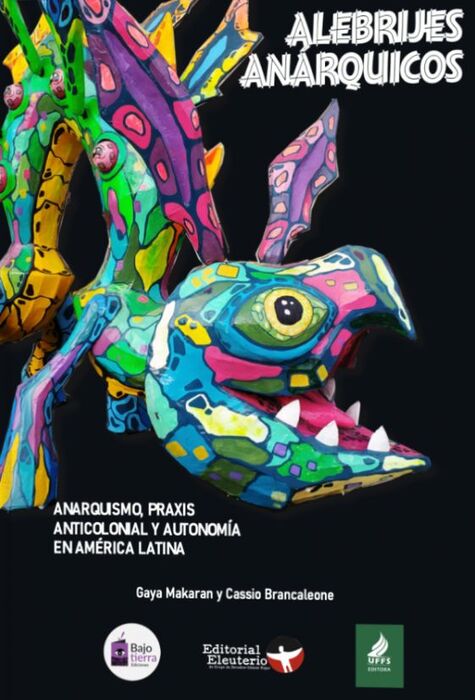
[1] This essay is based on the subchapter of the book Anarchic Alebrijes. Anarchism, anticolonial praxis and autonomy in Latin America co-authored with Cassio Brancaleone, next edition by the publishers Bajo Tierra in Mexico, Eleuterio in Chili and University UFFS in Brazil.
[2] In the original proposal by Dupuis-Deri and Pillet (2019) the word “l’anarcho-indigenisme” (in Quebec French) is used. However, as the same authors explain, to the Latin American context would rather be about an “anarcho-Indianism” that would have nothing to do with state, paternalistic or integrationist indigenism.
[3] To complete the debate on the decolonization of anarchism, I recommend two excellent texts by the authors: Laura Galián Hernández (2017) writes from a decolonized anarchism about anti-authoritarian experiences in Egypt and Maia Ramnath (2011) who does the same exercise of “decolonizing anarchism” from her review of anti-authoritarian history in India.
[4] Aymara word ch’ixi “is a color product of the juxtaposition, in small dots or spots, of two opposite or contrasting colors. It is that mottled gray resulting from the imperceptible mixture of white and black, which are confused for perception without ever completely mixing.” (Rivera, 2010: 69).
Bibliografía
Aguilar, Yásnaya Elena (2018). “Nosotros sin México: naciones indígenas y autonomía”. Nexos, sección Cultura y vida cotidiana. Publicado el 18 de mayo de 2018. Disponible en https://cultura.nexos.com.mx/nosotros-sin-mexico-naciones-indigenas-y-autonomia/
Corcuff, Philippe (2020). “De ciertas desventuras de la razón decolonial y poscolonial: homenaje crítico y libertario al cuestionamiento descolonizador” en Makaran, Gaya y Gaussens, Pierre (coords.). Piel blanca, máscaras negras. Critica de la razón decolonial. México. CIALC-UNAM, Bajo Tierra, pp. 205-224.
Cordeiro Ferreira, Andrey (2018). “Nacionalismo e internacionalismo na teoria e política anticolonial y pós-colonial” en VV.AA, Anarquismo anticolonial. Feira de Santana, Bahia. Editorial Anandé.
Dupuis-Deri, Francis y Pillet, Benjamin (coords.) (2019). L’anarcho-indigenisme. Montreal-Quebec. Lux Editeur.
Galián Hernández, Laura (2017). El Anarquismo Descolonizado una historia de las experiencias antiautoritarias en Egipto (1860-2016). Tesis doctoral. Madrid. Departamento de Estudios Árabes e Islámicos, Facultad de Filosofía y Letras, Universidad Autónoma de Madrid.
Jiménez, Aitor y Mariblanca, Pedro José (2016). “Negros, Salvajes y Anarquistas”. Periódico Diagonal. 25 de febrero de 2016. Disponible en https://www.diagonalperiodico.net/blogs/aitor-jimenez-y-pedro-jose-mariblanca/negro-salvaje-y-anarquista.html
Lasky, Jacqueline (2011). “Indigenism, Anarchism, Feminism: An Emerging Framework for Exploring Post-Imperial Futures” In Glen Coulthard, Jacqueline Lasky, Adam Lewis, and Vanessa Watts (Eds.). Affinities: A Journal of Radical Theory, Culture, and Action 5(1). Special Issue on Anarch@Indigenism, pp. 3-36.
Makaran, Gaya y Gaussens, Pierre (coords.). Piel blanca, máscaras negras. Critica de la razón decolonial. México. CIALC-UNAM, Bajo Tierra.
Montañez Pico, Daniel (2021). “Descolonizar el anarquismo” en Ruiz, Javier (coord.). Repensar el anarquismo en América Latina. Historias, epistemes, luchas y otras formas de organización. 115 Legion, Olympia WA, USA, pp. 64-81.
Ramnath, Maia (2011). Decolonizing Anarchism. An Antiauthoritarian History of India’s Liberation Struggle. Oakland. AK Press.
Rivera Cusicanqui, Silvia (2010). Ch’ixinakax utxiwa: Reflexión sobre prácticas y discursos descolonizadores. Buenos Aires. Ediciones Tinta Limón.
______________ (2018). Un mundo Ch’ixi es Posible: Ensayos Desde un Presente en Crisis. Tinta Limón. Buenos Aires.
Ruiz, Javier (coord.) (2021). Repensar el anarquismo en América Latina. Historias, epistemes, luchas y otras formas de organización. 115 Legion, Olympia WA, USA.
Scott, James (2016). Los dominados y el arte de la resistencia. Discursos ocultos. México. Era.
Taibo, Carlos (2018). Anarquistas de ultramar. Anarquismo, indigenismo, descolonización. Madrid. Catarata.
Catégories :Sans catégories



 liberté ouvrière