
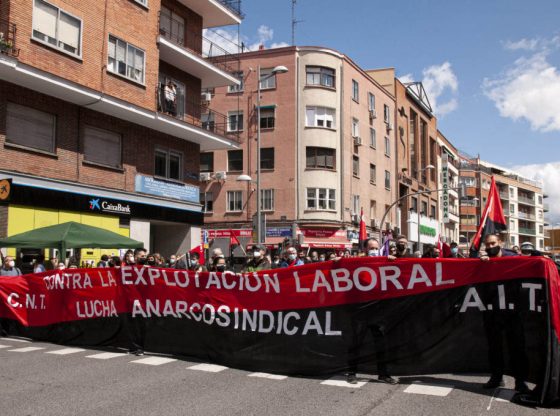
written by Alfonso Salvador
Originally posted online in Spanish on October 2nd 2023 Orto – Revista Cultural de ideas Ácratas #210
From the existing warfare of the present class society, it can only be affirmed that all agreements, all conquests, all possible truces, will always be ephemeral and unstable, and can only be preserved thanks to an opposition of antagonistic forces and resistances.
For this reason, in the class struggle between the bosses and the working class, a lasting alliance is never established, nor can it be established. Between them there are only armistices which, suspending hostilities for a time, seek a momentary truce to the actions of war, with the aim of regaining new forces and deploying their troops with the sole intention of reconquering or defending new and better positions in the struggle.
There is only one way out of this perpetual struggle, through a revolutionary action that makes disappear the social, political, economic and moral causes that relentlessly renew the confrontation which anarcho-syndicalists recognize, among others, in the principle of authority.
The revolutionary action in this sense is presented as the only possibility and hope in front of these tireless enemies, and it begins in some of the moments where, having established a total separation between the existing social state and the individual conscience of an important part of society as a whole, the possibility of its unleashing opens up after the combination of a series of extremely crucial factors.
In the first place, the revolution has to consist of a psychological response against a determined state of things that opposes the individual and collective desires and needs of society. In second place, as the result of a necessity before the will and aspiration of the body of the collectivity that clashes against the strata of the authoritarian regime that prevents it from growing. Third, that the ideological element is emphasized as fundamental above the individual interest that characterizes it. And fourth, that it is also a response to the collapse of the ethics on which the capitalist regime is based, as well as a moral bankruptcy in its economic aspect, and in the failure of its political expression that is unable, once again, to channel popular hopes through the notion of the State.
The revolution involves, therefore, a more or less violent event, which having rooted itself in the past for the preparation of its forces, proves itself in the present moment as a drive that tries to stop and neutralize the forces of the State, in order to allow the reordering of society on substantially different pillars and bases.
Therefore, the workers’ organizations should not only lead the conflicts with the aim that these, which are nothing more than a partial representation of the conflict and the existing struggle that characterizes class society, prepare the workers to achieve a victory and, most importantly, to prepare them for the social revolution. And, above all, to make known the need to rebuild the party of the revolution. Party that must be understood here as a faction of the working class that is in favor of the social revolution and not of the pursuit and conquest of power, but rather precisely those who impose on themselves the arduous objective of its abolition.
But for any organization whose purpose is to break with the principle of legality, it must organize the struggles through direct action, which prevents them from being reduced to a mere judicialization of these struggles.
The effort to organize conflicts by means of direct action will entail a whole set of lessons aimed at recovering workers’ culture and the spirit of association among the working class. The conquests and rights captured from the bosses have no significance in themselves for anarcho-syndicalism, since their true value is only found in that they prepare the working class, physically, psychologically and ideologically, to reach its revolutionary finality, which is embodied by Libertarian Communism.
In this sense, in workers’ struggles the conflict cannot be avoided, because if it were so on the side of the workers, the bosses would not take long to understand this situation and would rush to regain the lost ground. On the other hand, if the class struggle has a characteristic that defines it, it cannot be other than the always existing tension between these two, like a tension that one must be vigilant of in order to take advantage of the opportunity to defeat the opponent. But at the same time that the conflict is unavoidable, solidarity becomes unquestionable as it represents the only guarantee of success among the ranks of the workers, since what is crucial in this part is the degree of unity, firmness, perseverance, intelligence, quality and heroism of the militancy for the struggle.
Catégories :Anarcho-syndicalisme, Espagne, Journal Liberté Ouvrière, Organisations, Révolution, Texte



 liberté ouvrière