
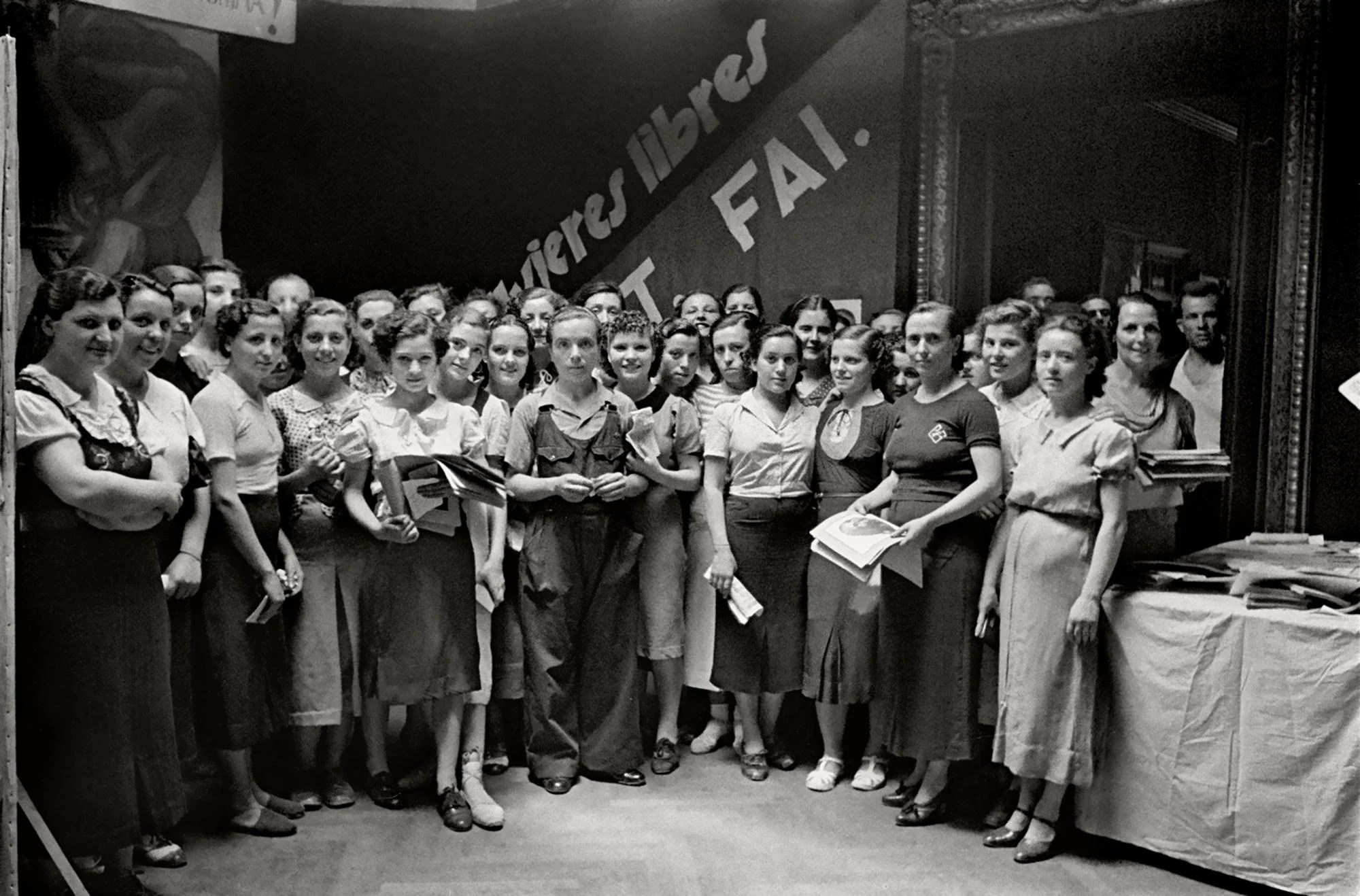
MUJERES LIBRES: INDIVIDUALITY AND COMMUNITY
Organizing Women during the Spanish Civil War
by Martha Ackelsberg
Published in RADICAL AMERICA Vol. 18 No.4, July-August 1984
Do you live in a town where women are relegated to a position of insignificance, dedicated exclusively to housework and the care of children? No doubt, many times you have thought about this with some disgust, and when you’ve noticed the freedom which your brothers, or the men of your households, enjoy, you have felt the hardship of being a woman…
Well, against all this which you have had to suffer comes Mujeres Libres. We want you to have the same freedom as your brothers… we want your voice to be heard with the same authority as your father’s. We want you to attain—without worrying about what people will say—that independent life you have wanted.
But, realize, that all this requires your effort; that these things don’t come for nothing; and that, in order to achieve them, you need the assistance of others. You need others to be concerned with the same things as you, you need to help them, as they will help you. In a single word, you must struggle communally; which is the same as saying, you must create a Group (Agrupacion) of women. 1
This passage comes from a pamphlet entitled, « How to Organize a Mujeres Libres Group, » written in Spain, probably in 1937.
Mujeres Libres was founded by women who were activists within the Spanish anarcho-syndicalist movement. Between April 1936 and February 1939, they built an organization which claimed over 20,000 members (overwhelmingly, working-class women), in 147 groups throughout Republican Spain. Their goal was to empower working women. They had come to believe, through their own and others’ experiences in the anarcho-syndicalist movement, that women’s empowerment required a separate organization, one which would address what they called « women’s triple enslavement: to ignorance, to capital, and to men. »
Unlike most socialist movements, which treat economic issues (i.e., class relations) as the most basic form of subordination, on which all others depend, anarchists saw hierarchy, formalized authority, as the crucial problem. Within that theoretical framework, there was a place to treat various types of subordination (e.g. political and sexual as well as economic) as more or less independent relationships, each of which would need to be addressed by a truly revolutionary movement. And, as early as 1872, in fact, they set the overcoming of women’s subordination as a goal of the movement.
Nevertheless, despite this openness on the theoretical level, women’s oppression had never been given a high priority within the anarchist movement. Most anarchists refused to recognize the specificity of women’s subordination; they assumed — if they were concerned at all — that women’s emancipation would follow either from their incorporation into the paid labor force or (more commonly) simply from the establishment of an anarchist society. At best, they insisted that the struggle to overcome women’s subordination must take place within and through movement organizations. As one woman activist stated,
We are engaged -in the work of creating a new society, and that work must be done in unison. We should be engaged in union struggles, along with men, fighting for our places, demanding to be taken seriously. 2
But the women of Mujeres Libres insisted that more direct action was necessary. In their view. although anarchist men may have « talked a good line » while out on the speakers’ platforms, most did not change their behavior toward women on a day-to-day basis. « It’s true that we have struggled together, » one woman recalled saying to her male comrades, « but you are always the leaders, and we are always the followers. Whether in the streets or at home. We are little better than slaves! » Mujeres Libres aimed both to overcome the barriers of ignorance and inexperience which prevented women from participating as equals in the struggle for a better society, and to confront the dominance of men within the anarchist movement itself. As Soledad Estorach, an ‘ ‘initiator » of the Barcelona group, told me:
In Cataluña, at least, the dominant position was that men and women should both be involved. But the problem was that the men didn’t know how to get women involved as activists. They continued (both men and most women) to think of women as assistants, accepted in a secondary status. For them, I think, the ideal situation would be to have a compañera who did not oppose their ideas, but in whose private life would be more or less like other women. They wanted to be activists 24 hours a day — and in that context, of course, it’s impossible to have equality. Men got so involved that the women were left behind, almost of necessity. Especially, for example. when he would be taken to jail. Then she would have to take care of the children, work to support the family. visit him in jail. etc. That, the compañeras were very good at! But for us, that was not enough. That is not activism! 3
When the women of Mujeres Libres talked about their aims, they used a word, capacitación. that has no exact English equivalent. « Empowerment » is probably the closest we can get. For them, as for anarchists in general, changing people’s consciousness of themselves and their places in society is a crucial step toward revolutionary change.
Yet the hard question, of course — for Mujeres Libres as for any social revolutionary movement — is how does that change in consciousness take place?
Although Mujeres Libres was an organization of women, which had as its purpose the empowerment of women, it was firmly rooted in the Spanish anarchist movement. In order to understand its program and strategy, we must take a few moments to locate it in that larger Spanish context.
One of the defining characteristics of the ‘communalist-anarchist tradition’ (by which I mean the tradition of Bakunin, Kropotkin. and Malatesta, on which the Spanish anarchist movement drew) is the insistence that means must be consistent with ends. If the goal of revolutionary struggle is a non-hierarchical egalitarian society, then it must be created through the activities of a non-hierarchical movement. Otherwise, participants will never be empowered to act independently, and those who direct the « movement » will end up as « directors » of the post-revolutionary society.
Crucial to their ability to imagine such non-authoritarian order was their insistence that individuality and community are not incompatible but, rather, mutually related. The social world they envision is not one of isolated individuals. Nor is it the moral and social chaos so often associated with the word « anarchism. » Rather, it is a world in which orderly human relationships are central. but order is assured via cooperation, rather than through competition or hierarchy.
Spanish anarchists and anarcho-syndicalists reflected this perspective in their commitment to decentralism and to a strategy of « direct action. » Direct action means that revolutionary activity and organization begin « where people are, » not through « intermediaries » such as political parties. Those local activities are then coordinated either through « propaganda by the deed,’’ exemplary action which brings adherents by the power of the positive example it sets, or by ‘’spontaneous organization, » non-coercive federations of local groups. The point, here, was to achieve order without coercion. This Spanish anarchists accomplished through what we might call « federative networking’’. Under the general aegis of the movement were trade unions, affinity groups, storefront schools, cultural centers, etc. But none of’ these groups could claim to speak — or act — for others. They were more « forums for discussion’’ than directive organizations. 4
Finally, Spanish anarchists believed that direct action takes place only within a context of « preparation’’; »spontaneous order » emerges only from processes that empower people. »Preparation » was the key to the success of a strategy of direct action. While they rejected the role of a party in laying down a blueprint for the revolution, Spanish anarchists also denied that fundamental social change could take place in a vacuum. People needed to develop confidence in themselves and in their comprehension of the world. But such preparation, if it was not to take a hierarchical form, could take place only through people’s experience of new and different forms of social organization.
The anarcho-syndicalist trade union movement (CNT) had been developing for close to seventy years by the time the Civil War officially began in July, 1936. Non-hierarchically structured union organizations, growing up in both rural and urban/industrial Spain, served as arenas within which workers could develop a sense of their ability — when united with others — to take control of their work, and of their lives. And unions drew on, while also nurturing, age-old traditions of collective action. Whether in nineteenth-century declarations of »comunismo libertario » in rural Andalusia, or in twentieth-century antiwar demonstrations and « bread riots » in Barcelona, thousands of men and women throughout Spain had had experiences of « direct action. » They had taken to the streets to demand that their needs be met and, more to the point, had sometimes used their power directly, as in « liberating » meat markets and stores of coal.
Rationalist schools and ateneos provided yet other contexts for ‘’preparation. » These schools. which grew up in many working-class barrios in Barcelona during the early 1930s, were supported by local unions, and staffed by a few dedicated teachers who had managed to get some training in an educational system otherwise totally dominated by the Church. They were models of participatory education, non-hierarchically organised, which attacked, illiteracy and built self-confidence and class consciousness at the same time. The cultural centers which usually operated out of the same building provided much-needed recreational opportunities — but always with a message. Trips to the mountains or the seashore, for example, were always accompanied by charlas. As one woman said of her experiences with the group, »ideas got stirred up, they created a sense of being compañeros and compañeras… That’s where we were formed, most deeply. ideologically. « Most ateneos had libraries, as well — which opened the doors for many young people who had no other access to books: « When I saw the library at the ateneo, I thought all the world’s knowledge was at my fingertips. »6
Thus, by the time of the Civil War, there was already an extensive network of anarchist and anarcho-syndicalist organizations and activities, especially in Cataluña, Aragon, and the Levant. What is less well-known is that the Spanish Civil War was not simply a war of « democracy » against « fascism. » Within the territory « controlled » by forces local to the Republic, a social revolution took place. Somewhere between 7 and 8 million people are estimated to have taken part in collectivizations of rural or industrial properties. The anarchists were among the groups most central to these efforts. Mujeres Libres was to operate in that larger revolutionary context — its 147 local groups were clustered in areas that were also major centers of the anarcho-syndicalist movement (in Madrid, Cataluña, the Levant, and Aragon).
Of the various « preparatory » activities I described, the schools and cultural centers, in particular, were especially important to women. Spanish society at the time was extremely sex-divided. Most men and women kept to a society almost exclusively of their own sex.
Beyond that, the subordination of women — both economic and cultural — was much more severe than that of men. Rates of illiteracy were higher among women than among men. Those women who did work for wages outside the home (predominantly unmarried women), were relegated to the lowest-paid jobs in the most oppressive work conditions. But these educational centers and youth organizations were sex-integrated, and they provided young women as well as young men an opportunity to enrich themselves culturally and to meet people of the opposite sex as equals. Finally, they could speak to the needs and experiences of women — and of unorganized workers — as unions could not, since they operated in an arena much broader than that of the workplace. Not surprisingly, virtually all the women with whom I spoke reported that their experiences in the ateneos and youth organizations were essential to their own development, and a critical component of their « preparation » for Mujeres Libres. Some women, then, did find a place for themselves within the community provided by the anarcho-syndicalist movement and, in particular, by its youth organizations. But many also recognized the limitations of those groups. On the one hand, as women, they were not always treated with the seriousness, respect, and equality they felt they (and all women) deserved. And, on the other (and I think this weighed even more heavily for many of the founders, since they were so committed to the anarchist movement and its project), they were all too aware of the inability of the anarcho-syndicalist movement to attract many competent women to its ranks, let alone to move them into positions of leadership. They attributed that failing both to the sexism of the men and to the « lack of preparation » of sufficient numbers of women.
I want to give you a very brief introduction to a few of those women. They captivated me completely when I met and interviewed them in Spain and France a few years ago. Some sense of who they were and how they lived their lives may also help to put what follows into perspective.
Many of the activists were young (though, of course, it should also be mentioned that it is the ones who were young in 1935-36 who are most likely to be alive now to tell their stories!) and unmarried. While many of them (as most working-class girls) had begun work somewhere between the ages of 8 and 12, their unmarried (and, more significantly, perhaps, childless) status allowed them a certain amount of time to engage in movement-related activities. Some of the women who were to be active in Mujeres Libres came from long-standing anarchist families, and talked about absorbing « the ideas » almost with their mothers’ milk.
Enriqueta Rovira, for example, is one of seven children of a dedicated anarchist couple, and the granddaughter of Abelardo Saavedra. one of the early anarchist travelling teachers who had been forced to leave the country at the turn of the century for having committed the crime of teaching field hands in Andalucia (rural Southern Spain) how to read. She cannot even describe how she « became » an anarchist — the ideas were there from the beginning. « These ideas came to-us without any imposition… It’s almost as if she [our mother] didn’t teach them, we lived them, were born with them. We learned them as you would learn to sew, or to eat. » 7 Even for Enriqueta — who came from a family which not only shared, but had nurtured, her beliefs — the association with others in an ateneo was crucial. It provided her with a strong sense of community which lasted over time: friendships she established there provided entree for her to do important work during the years or the Civil War.
Others came from families which had some leftist (or at least republican) leanings, but which did not define themselves as « anarchist. » Sara Guillén, for example, was about sixteen when the war broke out, and had had little to do with the movement before then. She became acquainted with the CNT through attending union meetings with her father, and became involved with Mujeres Libres — despite feeling, initially, that it was wrong, to have a separate organization for women — when she found herself defending the women’s right to meet against the taunts and jeers of her male peers.
Soledad Estorach’s father — a teacher, and a republican — had imbued her with a love of learning (and taught her to read — no small feat for a young woman in those years) before he died when she was ten. By age fourteen. she left home — to avoid a marriage that would have ‘ ‘confined me to inside the four walls of a house. » She went to Barcelona to find work which would enable her to support herself and her mother and sister. There she eventually joined a union, and became involved in an ateneo which, as she reported, opened a whole new world to her: « It was an incredible life, the life of a young militant. A life dedicated to struggle, to knowledge, to remaking society. It was characterized by a kind of effervescence, a constant activity. « 8
Still others came from families which seemed to have no connection with these « ideas. » Pepita Carpeña, for example, learned about the CNT from underground anarchist organizers who came to « proselytize » at the dances she attended as a teenager. In response to her father’s reluctance to allow her to attend meetings at night, she told him, « I am only doing what you should have been doing in my place: fighting for the emancipation of the workers! » and invited him to join her at a meeting. Convinced by the dedication he saw among the people at the meeting, he never bothered her again.
What all these women had in common was that all of them had been involved either in union activities or, more commonly, in ateneos and/or youth organizations. These experiences energized them with the vision of a new way to live and to interact with others. The networks created there provided important ongoing support which was both emotional and material: many women made life-long friends whose mutual support was essential during those times when (in the words of Soledad) « it seemed we lived on air alone.’’ Pepita Carpeña, for example, received a small stipend from the metalworkers union (where she had many friends) so she could do her organizing work full-lime for Mujeres Libres.
Others — particularly the Madrid founders — were older. And some of the activists were married with children. Pilar Grangel was in her late thirties when the War broke out, and had been the co-director (with her compañero) of what we would call an ‘’alternative school. » When she heard about Mujeres Libres, she began to work with them, offering classes in teacher training (as well as in basic literacy, etc. for adult women) to try to further the work she and her compañero had started on their own. Lola Iturbe was already thirty-four. She had started work at age nine and a half, and been introduced to anarchist ideas when she was about fifteen. Together with her compañero, she worked on the anarchist newspaper Tierra y Libertad and participated in Mujeres Libres as something of a « cultural worker. »
Mercedes Comaposada illustrates yet another route to activism. She was the daughter of a socialist father, and had little or no contact with the anarchist movement — or its ideas — until she was a law student in Madrid. Then, in 1933, a friend asked her to give some basic education classes at a CNT union’s center, which she gladly agreed to do. As she reported, ’’They wanted me to teach… But it was impossible, because of the attitudes of some ‘compañeros.’ They didn’t take women seriously. They thought all women needed to do was cook and sew. Women barely dared to speak in that context.‘’9 From that moment, she — and Lucia Sachez Saornil, together with her Amparo Poch a physician, was to found Mujeres Libres) – came, to an immediate understanding:
We had one million people against us. The great revolutionaries — Clara Zetkin. Alexandra Kollontai, Rosa Luxembourg – all tried to do something with women. But they all found out that. from within a party, within an existing revolutionary organisation, it’s impossible. I remember reading, for example, of a letter from Lenin to Clara Zetkin in which he says to her. ‘’Yes, all this you’re talking about the emancipation of women, is s very good. A very fine goal. But for later. » The interests of a party always come before those of women. 10
So, beginning late in 1933, they sent out letters to women throughout the country — both in the CNT and outside — announcing that they were thinking of starting an organization for women, and asking people to respond with issues they would like to see addressed. »Our great joy, » Mercedes told me, « was the response: they were incredibly enthusiastic, and there were always more.’’ 11
Meanwhile, in Barcelona, other women were having similar experiences, and developing similar responses. Soledad Estorach, who was one of the initiators of that group, described its beginnings:
Mujeres Libres (or what was to be Mujeres Libres) began to form in Cataluña starting in around 1934, building on the experiences that many of us militants had had with activism in mixed groups. Women would come once, to a Sunday excursion, perhaps, or to some discussion group — sometimes they would even join — but they’d never be seen again. In Barcelona, you know, the movement was very large and very strong… And there were lots of women involved in some industries — textiles and dressmaking, in particular. But we noticed that, even in that union, there were few women who ever spoke. We became concerned about the women we were losing. and thought about creating a group to deal with these issues. We sent out a call to all women in the libertarian movement in 1935, and, with those who responded, we formed a group and called it « Grupo cultural feminino, CNT. »12
Initially, these groups existed more or less under the auspices of the CNT. Their purpose was to develop more women as activists within the anarcho-syndicalist movement. But within a short time, they came to the conclusion that developing women activists was complex, and that they needed autonomy if they were to reach the women they wanted to reach, in the way they wanted to reach them
Eventually, those in Barcelona heard about the group in Madrid, and, in September of 1936, they »joined forces » under the name that the Madrid group had chosen — »Mujeres Libres. » Meanwhile, in April 1936, the Madrid group had published the first issue of the magazine of the same name; 13 issues were to appear by the time publication had to be stopped at the end of the War.
The founding of Mujeres Libres is a good example of « direct action, » or ‘’spontaneous organization. » And it points out the rootedness of Mujeres Libres in the anarchist movement which so insisted on the need for self-organization to meet people’s self-defined needs. Soledad captured well their own sense of what they were up to:
There were, of course, people who said this was wrong, that we should work only in mixed groups, and that we were in danger of falling into « feminism. «
Now I — and most of us — had never heard of « feminism » before. I didn’t know that there were groups of women out there in the world organizing for women’s rights. There were one or two within our group who had heard of feminism — they had been to France. But I didn’t know such things existed in the world! What I’m trying to say is that we were operating within our own situation, on the basis of our own experiences. We didn’t import this from elsewhere. We hadn’t even realized it existed! 13
(It’s important to note here that they — and virtually all anarchists — had a very negative reaction to »feminism which they identified with middle-class women’s struggle for the vote and/or professional privileges. As an organization, primarily, of working-class women, dedicated to the emancipation of working-class women, they saw individualist feminism as irrelevant, if not contrary, to their entire project.)
They argued that women had to organize independently of men, both to overcome their own subordination and to struggle against male resistance to women’s emancipation. They based their program in the same commitments to direct action and preparation which informed the broader Spanish anarchist movement, and insisted that women’s preparation to engage in revolutionary activity must develop out of their own particular life experiences.
The element of autonomy was crucial to them — it was what made possible that self-definition essential to empowerment. As Lucia Sanchez Saornil wrote in 1935, « I believe it is not the place of men to establish the role of women in society, however elevated that might be. The anarchist way, I repeat, is to let the woman act on her own freedom, without either guides or enforcement; to let her move in the direction that her inclinations and abilities direct.’’14
Or, as Enriqueta Rovira says she used to try to explain,
I used to say to the compañeros, »We don’t want to be free to take away your jobs, or to take your spades or your hammers, or the bread from your arms. We want to be free to reclaim our rights. Who gives you the right to have four or five women, when we have to make do with one [man], even if we have desires for other things. Why do we have to limit ourselves to being cleaners, when we have the ability to be a secretary, or a director, or… who knows what? No, this is what you have to realize about women: that women… are capable of everything. Equality is everything.’’ 15
They aimed to provide a context within which women could overcome their subordination and develop a new counciousness of themselves. Mujeres Libres’s programs addressed problems of particular concern to women — those which, according to their analysis, constituted the main components of women ‘s subordination — i.e. illiteracy, economic dependence and exploitation, and ignorance about health care, childcare, and sexuality. Meanwhile, the structure of the organization — namely its autonomy from existing male-dominated organizations — was designed to build up, and protect, that newly developing sense of self.
While they did not officially set priorities among what they saw as the sources of women’s subordination, most of the organization’s activities focused on overcoming ignorance and economic exploitation. They mounted a massive literacy drive to provide the foundation necessary for an « enculturation of women, » with classes given in towns and villages wherever they had organizations. In addition, they set up major centers in the cities where they were strongest — « Mujeres Libres Institutes » in Madrid and Valencia, and the « Casal de la Dona Treballadora » (Institute for Working Women) in Barcelona — which offered elementary literacy classes; more advanced classes in languages, typing, stenography; « professional courses » such as nursing, childcare, craft skills (electricity, mechanics, etc.) education. and health care; and courses in what they termed formacion social: union organization, economics, and general weekly meetings which provided opportunities to meet and talk with other women (paving the way for political activism). They saw literacy as a tool to develop women’s self-confidence as well as to facilitate their full participation in society and social change: « It was almost like a school for activists… We didn’t exactly indoctrinate people, but we did more than just technical training. We encouraged them to pay attention, to become activists.’’16
Mujeres Libres saw women’s economic dependence as rooted in an extreme sexual division of labor, which assigned women the lowest-paid work under the most oppressive conditions. To overcome it, they worked closely with CNT unions, sponsoring training and apprenticeship programs in many factories. As Mercedes Comaposada described them, these programs had multiple functions. ‘’The work section was probably the most important. We started in that arena immediately, because it was essential to get women out of the house. Eventually, there were Mujeres Libres groups in almost all the factories. Many of these probably focused on issues that had little to do with women’s emancipation, but still provided a context for women to talk about work-related concerns. In rural areas, they sponsored agricultural training programs. They also advocated and supported childcare facilities, both in neighborhoods and at workplaces, to make it possible for women to work. And they fought to equalize salaries between men and women. Nevertheless, it is important to note that they directed little attention to the sexual division of labor, itself, or to the implications for sexual equality or the stereotyping of some work as women’s and some as men’s.
The organization, as a whole, had no clear position on the cultural subordination of women. Some of its members (including Ampara Poch and Lucia Sanchez Saornil, two of the founders) strongly criticized « bourgeois morality » (and, particularly, notions of marriage and monogamy) which, they said, subordinated women and limited everyone’s potential for relationships. They argued against the definition of women solely as mothers. ‘’We wanted to make clear that the woman is an individual and she has value and worth even apart from being a mother. We wanted to get rid of the myth of ‘THE MOTHER.’ At the very least, we wanted madres conscientes [mothers by choice] People should be able to chose whether, when, and how to have children. But most members were probably committed to the ideal of monogamous relationships, even if not to legal marriage. And, with rare exceptions, the ideal of ‘free Iove’ (even in the sense that people should be free to enter and leave monogamous relationships when they pleased, not according to church- or society-related criteria, seemed to apply more to men than to women.
There was greater agreement on other aspects of cultural subordination. One of Mujeres Libres’s most innovative goals (though one they barely were able to put into practice because of the demands of the War) was the creation of liberatorios de prostitución, centers where former prostitutes could go and be supported while they retrained for better lives.
Another major focus was health care. Up until the outbreak of the War, the Church had undertaken the provision of whatever health care was available in Spain. Mujeres Libres trained nurses to replace the nuns, and developed educational and hygiene programs for maternity hospitals and neighborhood centers. These aimed to overcome women’s ignorance (perpetuated by the Church) about their bodies and their sexuality — an ignorance which Mujeres Libres saw as another root of women’s subordination to men.
It is important to note that its program and organization were quite different from those of other women’s organizations in Spain at the time, most of which were the ‘’women’s auxiliary » of various party organizations. Mujeres Libres constantly reminded members, « In the midst of all the sacrifices… we are working to find ourselves, and to situate ourselves in an atmosphere which, until now, has been denied to us: social action. In an important parallel to the anarchist movement’s position about social revolution, they argued that women’s emancipation need not await the end of the war, and that women could best help both themselves and the war effort by insisting on their equality and participating as fully as possible in the ongoing struggle.
Overcoming women’s subordination, however and incorporating them fully into revolutionary struggle, required more than an attack on the sources of subordination. Women’s sense of self had to change, so that they could begin to see themselves as independent, effective actors in the social arena.
Consciousness raising was an essential aspect or their program, and the organisation lost opportunities to engage women in the process. They set up talks and discussion groups, to let women get used to hearing the sound of their own voices in public. What they called preparacion social became an clement of every project they undertook. In cooperation with unions, for example, groups of women from Mujeres Libres visited women working in factories, ostensibly to get them more involved in union activity. In groups of two or three, Mujeres Libres’ ‘’organizers’’ would visit up to fifty factories a day, stopping the assembly lines for fifteen minutes or so to talk with the workers. While they were there, they gave little « pep talks’’ to the women about the significance of their participation as women. In some areas (e.g. Terrassa), thev arranged for women unionists to meet independently of men, both so that they could talk about issues or particular concern to them, and so that they could support one another to participate more actively in the union meeting. In Barcelona, the group set up ‘’flying daycare centers,’’ to provide in-home childcare for women to enable them to attend union meetings.
The separate organization allowed them the freedom to develop independent programming that appealed to the specific needs of women, and to address, directly, the issue of their subordination. In addition, as a number of women were quick to point out, it forced them to take responsibility in areas where, otherwise, more ‘’experienced » men would « naturally » take over.
Conclusion
Clearly, the women of Mujeres Libres drew not only on their own experiences within the anarcho-syndicalist movement, but also on the perspectives on society and social change which animated it. Their goal of empowering women through participation in groups which responded to the specific realities of their day-to-day lives followed directly from the anarchist commitment to direct action. Neither individual male anarchists nor the major organizations of the Spanish anarchist movement were necessarily enthusiastic about (or even supportive of) their programs and accomplishments as Mujeres Libres might have wished. Nevertheless, they attempted to put into practice an orientation toward social and political life to which anarchists had long been committed, at least in theory: a respect for diversity.
The women of Mujeres Libres were thoroughly rooted in anarchism and in the goals and strategies of the Spanish anarcho-syndicalist movement. Yet, in insisting on the need for separate organization, they apparently moved beyond the bounds of where the movement, as such, was willing to go. While their own accomplishments may have been limited — most dramatically because of the wartime situation in which they were operating — their programs suggest a vision of the relationship between individuality and community from which there is much we can learn.
Consciousness raising is essentially a process of empowerment. Recognizing that others share concerns and difficulties which we assume to be « personal » is an important first step toward the development of a »political » consciousness – a sense that our lives are socially constructed and that the world can be changed. So, although it takes place in the person or individuals, consciousness raising is, fundamentally. a collective endeavor. Its success is rooted in — and, in fact, helps to create and cement — a sense of community. And it is that sense of community which, in turn, empowers its participants.
That insight is an important one — but one which has often been lost in the claims that feminism is about « personal advancement » or « equal opportunity. » The classical liberal perspective (to which those us of the US are heir), in that community and individuality are necessarily at odds. More accurate, I think is the perspective from which Mujeres Libres acted: that people achieve their full personhood not in conflict with, but in the context of a community – but one which, of course values and respects them.
Let’s look at that in a bit more detail. As citizens of ‘’liberal democratic politics,’’ in particular, many of us tend to equate ‘’community’’ with sameness. Hence the common assumption (often leveled against anarchists or other egalitarians) that community is incompatible with creativity and individuality (because creativity is stifled by it). That claim is the source, I think, of some significant problems in American politics, feminist or other. For we seem to operate on the assumption that truly democratic politics, respectful of individuality, is rooted in contract and based on interests – interest which inhere in us as individuals, divorced from any race, class, or cultural connections. Much of liberal democratic politics seems based on the assumption that organizing around differences (especially those based in race, class, gender, or culture) undermines the unity of the whole.
As members of the non-dominant groups in the US have been pointing out for some time, however – most recently, within the context of the women’s movement – such as approach to politics (and personhood) in fact disempowers people, and can well serve to deny our individuality. We are coming to see, for example, that there is probably no such thing as ‘’woman’’ – each of s is rooted in the particular cultural, ethnic, religious, etc. communities in which she grew up and to which she is, to some extent, connected. To ask of one another that we discard those identities (and the connections in which they are rooted) in the name of some abstract ’womanhood’’ is to deny the richness of our particular lives – in much the same way that men’s reticence to acknowledge women’s particular experience in the name of ‘’humanity’, denies us the fullness of our personhood and history.
We need to begin to think about ‘’community’’ in the other ways – which explode its alleged incompatibility with personal development. And here is where I think anarchist notions can be of some help. First, there are, surely, aspects of ourselves which we can realize only in relationships with others – and some of these rupture networks of others, i.e. community. We must begin to see communities not just as a means to allow each of us to pursue our self-defined ends, but as the contexts within which we realize, and express, the fullness of who we are. Conversely, since virtually all of us will have roots in more than one of these contexts, any community which is to nurture our wholeness must not only recognize, but actively welcome, diversity into its very definition.
What I find so appealing about the women of Mujeres Libres is that, in some way, they were struggling with these same issues. With all their commitment to the goals of the anarchist movement – and their rootedness in its community – they recognized that something was missing for them, as women. That was a painful realization for most of them. Some of those who were to become activists even opposed the idea of a separate organization when they first heard about it, because the anarcho-syndicalist movement in which they had been nurtured was so important to them that they feared anything which might undermine its unity. Yet, over time, each of those women came to insist that, both for the sake of her own and other women’s development (as persons and as anarchists) and, in fact, for the sake of the movement, itself, a separate organization, devoted to women’s emancipation, was essential.
Their experience can, perhaps, point us toward a different way of thinking about our reality. In their view, women could be empowered – and active- in the anarchist movement only if they could at the same time acknowledge and build on their ties of common experience with other women. Although many men in the anarchist movement saw their program as divisive of unity, these women most certainly did not. Rather, they seemed to insist, it is not only the acceptance, but the nurturing of such ties within the context of the larger movement which, ultimately, makes possible an empowered unity.
Mujeres Libres had little time to turn its vision into reality, so we cannot know how much they might have accomplished. Nor, so far as I can tell, did they have a clear formula for how to make it all work. But their own organization was a federation of autonomous local groups; and the relationship they wanted (but could not have) with the larger anarchist movement was also that of an autonomous set of units operating within the larger, federated, whole. Perhaps that model (and a sense of anarchist commitments to direct action and spontaneous organization) can provide us with some clues.
I think there is much we can learn from their efforts — from their recognition that, if we are truly to respect and nurture individuality, we must provide not only ‘’small communities » to empower. but larger communities which respect and welcome that diversity (and the diversity embodied in each of us). Rather than assuming that we must sacrifice the full development or our personhood for the good of the community. or sacrifice the rewards of community life and action for individual ends, we can begin to imagine — and strive for – a world where creativity is nurtured through connection, and communities can truly empower their members.
- El Comité Nacional, Mujeres Libres, ‘’Como Organizar una agrupación Mujeres Libres’’ (Publicaciones Mujeres Libres), cited in Mary Nash, ed., ‘’Mujeres Libres’’ España, 1936-1939 (Barcelona: Tusquets Editor, 1976). p. 76
- Igualdad Ocana, interview, Hospitalet, February 14, 1979
- Soledad Estorach, interview, Paris, January 6, 1982
- See, for example, Temma Kaplan, Anarchists of Andalusia (Princeton: Princeton University Press, 1978). pp206-207
- Enriqueta Rovira, interview, Castelnaudary, France, December 29, 1981
- Soledad Estorach, interview, Paris, January 4, 1982
- Interview, December 28, 1981
- Interview, January 4 and 6, 1982
- Mercedes Comaposada, interview, Paris January 5 1982
- Interview, Paris, January 3, 1982
- Mercedes Comaposada, interview, Paris January 5 1982
- Soledad Estorach, interview, Paris January 4 1982
- Soledad Estorach, interview, Paris January 4 1982
- ‘’Resumen al margen’’, cited in Nash. Ed., ‘’Mujeres Libres’’. p.64
- Enriqueta Rovira, interview, December 28,1981
- Soledad Estorach, interview, Paris, January 4 1982
- Interview, Paris, January 5 1982
- Cited in Carmen Alcalde. La mujer en la Guerra civil española. (Madrid Editorial Cambio 16, s.d.) p.154
Martha Ackelsberg teaches in the government department at Smith College and is active in the women’s movement. She has been exploring how insights from the women’s movement about friendship and community can contribute to and challenge traditional political theory. This article is part of a book she is writing on Mujeres Libres.
Catégories :Anarcho-syndicalisme, Espagne 1936, Féminisme / Pro-féminisme, Pro-féminisme, Texte


 liberté ouvrière